
KYC Explained
If you have ever tried to invest in a mutual fund, buy insurance, or open a bank account, you may have heard the term KYC. Many people find it confusing at first, so let’s break it down in simple English.
What is KYC?
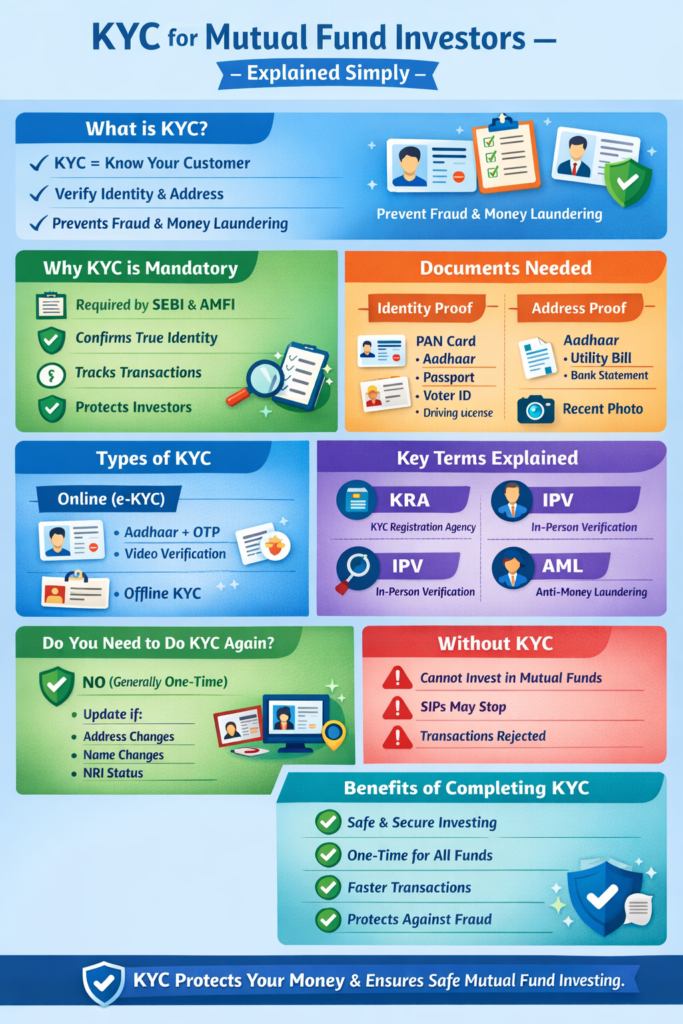
KYC stands for Know Your Customer.
It is a process used by financial institutions (like banks, mutual fund companies, stockbrokers, etc.) to confirm the identity and address of a customer before allowing financial transactions.
In simple words:
KYC is like showing your ID card before entering a secured area. It proves that you are a real and genuine person.
Why Was KYC Created in the First Place?
Financial systems like banks and mutual funds deal with huge amounts of money. Without proper checks, criminals may misuse the system for illegal activities.
KYC helps to prevent:
✔ Money Laundering (hiding illegal money by making it look legal)
✔ Terrorist Financing (funding harmful activities)
✔ Identity Theft (someone pretending to be you)
✔ Fraud and Financial Scams
So, KYC protects both the financial institution and the investor.

Who Makes KYC Mandatory?
In India, KYC rules for mutual funds are governed by:
These authorities ensure that the Indian financial markets remain safe and transparent.
Why is KYC Mandatory for Mutual Fund Investors?
Mutual funds allow people to invest money and earn returns. Since money is involved, the system must be safe.
KYC is mandatory because it helps:
1. Verify Investor Identity
Mutual funds must know who is investing. This prevents fraud and protects honest investors.
2. Track Financial Activities
If a suspicious transaction happens, authorities can investigate easily.
3. Protect Investors’ Money
KYC creates a secure investment environment and reduces chances of misuse.
4. Follow Government Regulations
AMCs (Asset Management Companies) must obey SEBI rules. KYC ensures compliance.
What Documents Are Needed for KYC?
To complete KYC, you generally need:
Proof of Identity (POI) – example:
- PAN Card
- Aadhaar Card
- Passport
- Voter ID
- Driving License
Proof of Address (POA) – example:
- Aadhaar
- Passport
- Driving License
- Electricity bill
- Bank statement
Photograph
- A recent passport-size photo (physical KYC)
- Live photo (for online KYC)
PAN Card is Compulsory
Because PAN helps track financial transactions in India.
Types of KYC (Modes of Completion)
There are mainly two types:
1. Offline KYC
- Submit physical documents
- Sign forms
- In-person verification may be done
2. Online KYC (e-KYC)
- Aadhaar-based verification
- Paperless and quick
- Can submit through KRA (KYC Registration Agencies)
For mutual funds, popular KRAs include:
- CVL KRA (CDSL Ventures)
- NDML KRA
- Karvy KRA
- DOTEX KRA, etc.
Understanding Some Complicated Terms
Here are terms that often confuse investors — explained easily:
✔ KRA (KYC Registration Agency)
A KRA stores and verifies KYC records.
Once you register KYC with one KRA, it works for all mutual fund companies.
✔ IPV (In-Person Verification)
A simple face-to-face verification process to confirm that the person exists in real life.
In online KYC, this may happen through a video call.
✔ e-KYC
Electronic KYC using Aadhaar number and OTP.
It is fast, digital, and paperless.
✔ AML (Anti-Money Laundering)
Rules made to stop criminals from using financial systems to hide illegal money.
✔ FATCA
A US law that requires financial institutions to report details of investors who are US taxpayers.
(Needed only if applicable to you)
Is KYC a One-Time Process?
Yes, mostly you do KYC only once.
After successful registration:
- You can invest in any mutual fund
- You don’t need to repeat KYC for every AMC
Sometimes details may need updating if:
- You change address
- Your name changes (marriage, legal reasons)
- You become a Non-Resident Indian (NRI)
What Happens If You Don’t Do KYC?
Without KYC, you cannot invest in mutual funds.
Even if you have existing SIPs, they may be stopped if your KYC becomes invalid due to mismatches or missing details.
Benefits of Completing KYC
✔ Safer and transparent investment
✔ One-time setup for all mutual funds
✔ Faster transactions and redemptions
✔ Protection from fraud and misuse
✔ Mandatory legal compliance
So doing KYC is not just a rule — it’s for your own financial safety.
Common Myths About KYC
| Myth | Reality |
|---|---|
| KYC is risky | No, it protects your money |
| KYC shares my data publicly | No, data is protected by law |
| KYC takes a long time | Online KYC is quick & simple |
| Only big investors need KYC | Every investor needs KYC |
Conclusion
KYC may feel like paperwork, but it plays a very important role in keeping mutual fund investments safe, legal, and transparent. It protects both the investor and the financial system from fraud and misuse.
Whether you are a new investor or experienced, understanding KYC helps you invest with confidence.
Final Takeaway in One Line:
KYC exists to protect your money and ensure safe investing — that’s why it is mandatory.
Leave a Reply